The Story of the Spitfire
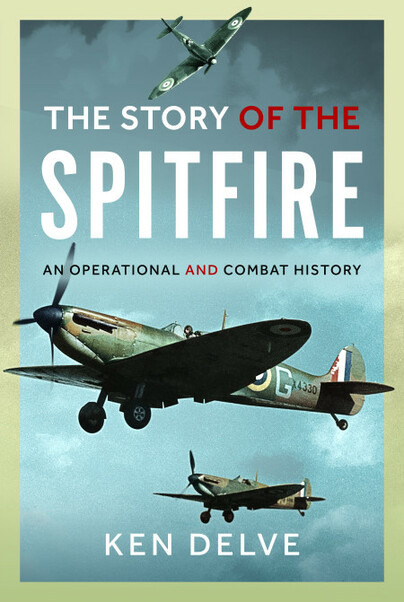
An Operational and Combat History
By Ken Delve
To many people the Supermarine Spitfire was Britain’s saviour during the Battle of Britain and the embodiment of air combat during the Second World War. The Story of the Spitfire presents a thrilling appraisal of this unique aircraft, focusing on its fighting capability and the tactics of the pilots who flew it. Using official evaluations and reports, alongside technical and tactical developments, plus the recollections of Spitfire pilots, Ken Delve provides a fascinating insight into the combat career of this legendary aircraft.
Despite some problems with their new aircraft, the Fighter Command pilots of 1938 were generally delighted with the Spitfire – speed, manoeuvrability and firepower were all far greater than they had been with the earlier biplanes. In tactics and training the RAF was outdated, but it adapted quickly and the air battles over Britain in late 1940 forged the Spitfire legend. How justified was the legend? There were only nineteen Spitfire squadrons in Fighter Command during the Battle of Britain; it was only later, as the RAF turned to the offensive, that the number of Spitfire units increased dramatically.
At certain times the combat initiative was lost to improved Messerschmitt Bf 109s and Focke-Wulf Fw 190s, but with increased performance and better training, the Spitfire clawed back the advantage. By 1944 the Spitfire was operating as a fighter-bomber in various theatres of war, with new tactics and new problems. Many fighter pilots thought that having bombs strapped under the aircraft verged on an insult – but with aerial targets in short supply, this was the most effective, if risky, way of taking the war to the enemy.
After the war the Spitfire saw action right up to 1948 in the Arab-Israeli War. Today there are approximately seventy airworthy Spitfires in existence and R.J. Mitchell’s remarkable aircraft is still the highlight of flying displays around the world.
Vintage Airfix Review:
There are already more books on the Spitfire than most of us have shelf space for, and any new addition must justify its place on those groaning timbers. Ken Delve’s thorough and purposeful volume, originally published in 2007 and now reissued by Air World, makes a convincing case for itself by approaching the subject from a distinctly different angle. Rather than retreading the familiar ground of Mitchell’s genius or the romance of the Battle of Britain, Delve concentrates on the Spitfire as a working fighting machine, tracing how it was actually flown, trained for, and tactically employed across every theatre of the war.
The research is formidable. Delve draws heavily on official records, including the Air Fighting Development Unit reports that fill the book’s substantial annexes. These are not decorative additions. Reading a comparative trial between the Spitfire VB and the Focke-Wulf 190, written in the clipped, frank language of service evaluators, is genuinely illuminating, revealing the aircraft’s real strengths and uncomfortable limitations without sentiment or polish. For anyone who has ever sat squinting at a 1:72 Spitfire V wondering how it really stacked up against its opponents, this is precisely the kind of detail that brings a kit to life.
The writing itself is measured and clear, if occasionally workmanlike in its thoroughness. Alfred Price’s foreword sets the tone well, and the chapter structure, spanning development through post-war operations and carrier service, is logical and well paced. Occasionally the sheer weight of extracted documents can slow the momentum, but this is a minor complaint against a book that never mistakes drama for accuracy.
This is not a book for casual readers seeking swashbuckling pilot narratives alone, though those are present. It is, rather, essential reading for the serious enthusiast: the modeller who wants to understand the aircraft beneath the markings, and the historian who values evidence over legend.
A well-assembled, authoritative piece of work. Highly recommended.