
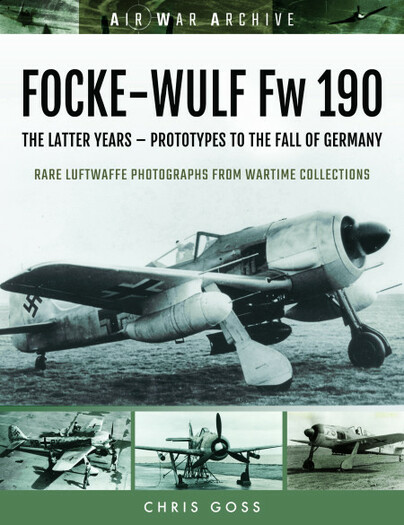
The Latter Years – D-Day to the Fall of Germany
By Chris Goss
As the war began to turn against Germany, the Luftwaffe was forced to defend the Reich against increasingly overwhelming numbers of Allied fighters and bombers. The Focke-Wulf Fw 190, together with the Bf 109G, was the mainstay of the Luftwaffe’s Reichsverteidigung (Defence of the Reich) fighter force, both by day and by night.
As the war progressed, the US Eighth Air Force, suffering heavy losses over Germany, changed tactics. The escorting US fighters had been expected to fly alongside the bombers to provide close protection. But this meant that they could not chase after the enemy when in combat, having to return to the bombers. So, from early 1944, the decision was made to free the fighters, allowing them to fly ahead of the bomber stream clearing the skies of German fighters.
To counter this, the Luftwaffe developed the Gefechtsverband, or battle formation, composed of two units of Bf 109s and one Sturmgruppe of Fw 190s. In Gefechtsverband operations, the Bf 109s would engage the Allied fighters, particularly the long-range P-51 Mustangs, leaving the more heavily-armed Fw 190s to attack the bombers. Though the large Gefechtsverband formations were unweildy and not always effective, when they did work well, the powerful and well-armoured Fw 190s wreaked havoc amongst the US bombers.
Meanwhile, on the Eastern Front, the Fw 190 was incresaingly relied upon for fighter and Jabo missions against a dogged Soviet Air Force. With the tide well and truly turned against the Luftwaffe, newer versions of the Fw 190, such as the F and G variants, were intruduced as well as the superlative D-9 which was powered by the Jumo 213 A engine, armed with two MG 131s and two MG 151/20 guns and had a new fuselage and wings.
In this second volume detailing the service of the Fw 190, Chris Goss has assembled photographs, many of which have come from the archive of the late Dr Alfred Price, to illustrate the final years of the type’s war.
Vintage Airfix Review:
Chris Goss is refreshingly candid from the outset: this is not a comprehensive technical history, but an image-led archive with enhanced captions, built around the extraordinary photographic collection left to him by the late Dr Alfred Price. That inheritance proves formidable. Each image is meticulously annotated with Werk Nummern, unit designations, pilot details, and where known, the precise fate of the aircraft. The chapter devoted to close-up views alone justifies the purchase price. Cockpit interiors, undercarriage bays, weapons installations and engine configurations are documented with a clarity that helps enormously when reaching for the paintbrush or the scriber.
If there is a limitation, it is the one Goss himself acknowledges: readers seeking a narrative history will need to look elsewhere. For Luftwaffe aviation enthusiasts, Airfix or Tamiya 190 builders hunting reference material, and anyone drawn to the mechanical drama of this aircraft, it is a thoroughly worthwhile addition to the shelf. Highly recommended.