
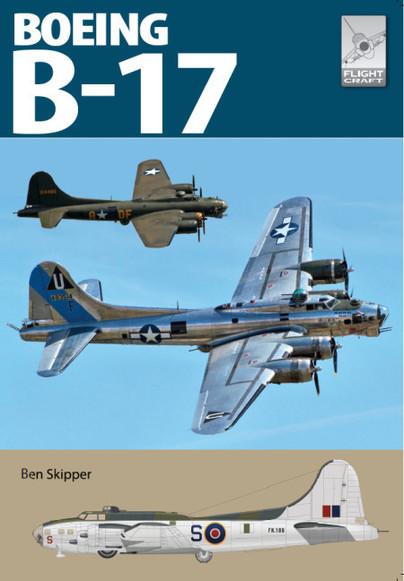
By Ben Skipper
The B-17 Flying Fortress, a term coined by a Seattle Daily Times report in 1935, was a quantum leap in offensive air power. Designed for a nation whose foreign policy was still deeply isolationist, and an Air Corps whose in-service bomber fleet was dominated by bi-planes, the B-17, with its four engines, huge wingspan, enviable payload – almost double that of contemporary bombers – and all metal construction, ushered in a new age.
For an aircraft of its size and relative complexity the B-17’s design and development was heralded by a host of key innovations with the unveiling of the XB-15 (Boeing 294), including engine access crawl ways, enhanced endurance and massive load capacity. Within a year the Y1B-17 or Model 299 had refined ideas from the XB-15 and produced a sleek, attractive-looking aircraft. By 1937 all testing had been completed and the first 12 aircraft were delivered to 2nd Bombardment Group for assessment.
At the start of the Second World War the still-new B-17 was just beginning to fill the ranks of US bomber squadron’s and by early 1941 the B-17C, arguably the fastest B-17 built, was flying in RAF Service. The B-17 was soon flying over Europe with the newly-created United States Army Air Forces, as well as taking the fight to the Japanese in the Pacific and to the Axis in the Mediterranean.
When production of the B-17 was halted in April 1945, at which point the B-17 had been supplanted by the B-24 in the Pacific, over 12,700 B-17s had been built. The type would bow out as a bomber not long after the war’s end, though a few would soldier on as SB-17 air-sea rescue aircraft. Ultimately the B-17 would fly with 26 countries.
This Flight Craft title offers the modeller an exciting selection of photographs, illustrations and showcase examples to help build their own version of this icon of the skies.
Vintage Airfix Review:
Few aircraft carry the weight of legend quite like the Boeing B-17, and Ben Skipper’s entry in Pen & Sword’s Flight Craft series does it considerable justice. Covering design and development, camouflage, variants, and operational history in clear, accessible prose, the book traces the Fortress from Boeing’s inter-war commercial experiments through to the political battles that nearly strangled American airpower at birth. The writing never condescends, and the historical context — particularly around Billy Mitchell and the doctrinal debates of the 1930s — is genuinely illuminating.
Where the book earns its place on the workbench, however, is in its modelling content. The kit survey is honest and thorough, ranging from Airfix’s excellent 2016 new-tool 1/72 to HKM’s impressive 1/32 offering, with aftermarket coverage from Eduard, Metallic Details, and Scale Aircraft Conversions among others. The showcase builds, complete with detailed construction notes, offer real inspiration. A minor gripe is that photographic reproduction in digital format occasionally undersells the subject. For the scale modeller and military history enthusiast alike, this is a compact, well-assembled reference. Recommended.