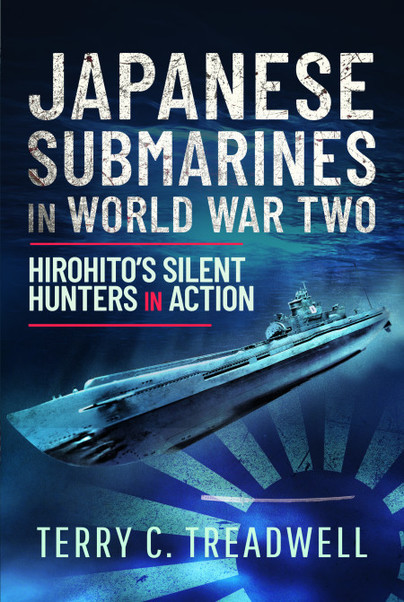
Hirohito’s Silent Hunters in Action
By Terry C Treadwell
The Imperial Japanese Navy developed the submarine faster than any other country in the world. But as a result of rivalries between the two military hierarchies, the Army and the Navy, they never utilised the submarine to its full extent. Nevertheless, during the Second World War, Japan deployed a number of unique submarines.
These included the Type B1 which carried a Yokosuka E14Y1 reconnaissance seaplane in a watertight capsule attached to the deck of the submarine. One of these aircraft carried out two bomb attacks on a forest in Oregon by dropping six incendiary bombs, taking the war to the American mainland. The use of aircraft from submarines as scout planes proved not to be as successful as hoped, mainly because of the difficulty after launching the aircraft of it finding the submarine again in the vast Pacific and Indian Oceans. The Japanese also developed the giant I-400 class submarines that carried three Sieran bombers.
There were other notable actions involving IJN submarines. This included I-17 that attempted to shell, unsuccessfully, an oil refinery off the coast of Santa Barbara, causing a major panic along the West Coast of America. Also memorable are the midget submarines that attempted to attack Pearl Harbor, and the submarines that carried the one-man submarines (Kaitens) and the human torpedoes.
The submarine losses suffered by the Japanese Navy as the war progressed, when Allied, and in particular US, destroyers and aircraft hunted them down are all recorded in this comprehensive account of a fascinating element of the war at sea.
Vintage Airfix Review:
There is something quietly compelling about the submarine as a subject, and the Japanese Imperial Navy’s underwater arm has long deserved a thorough account in English. Treadwell begins further back than you might expect, tracing the submarine’s origins from sixteenth-century theorists through to the moment Japanese naval officers, visiting a New Jersey shipyard in 1897, first laid eyes on a Holland boat. It is a scene that rewards patience: watching Japan absorb, adapt, and ultimately construct the largest submarine fleet on earth is genuinely fascinating, and that developmental arc is established with real clarity. When the book reaches the Pacific War proper, the coverage tightens appreciably, with the midget submarine attacks on Pearl Harbor, the extraordinary I-400 aircraft-carrying class, and the persistent strategic misjudgements of the Imperial Naval High Command all handled with a good eye for operational detail.
The writing is accessible rather than scholarly, and Treadwell occasionally allows narrative pace to come at the expense of deeper analytical rigour. Those seeking a forensic strategic study may find the treatment somewhat surface-level in places. That said, the appendices alone, listing specifications, losses, and combat successes in precise detail, are worth the price of admission for modellers; exactly the sort of reference material you find yourself reaching for repeatedly at the workbench. A reliable, well-organised introduction to one of the war’s most overlooked subjects, and thoroughly recommended for Pacific War enthusiasts and anyone building from the growing catalogue of Japanese submarine kits.