
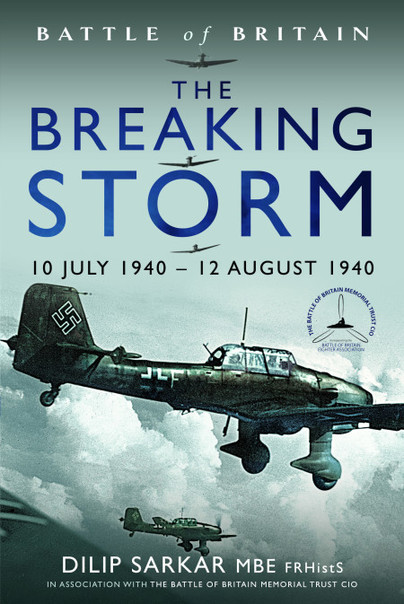
10 July 1940 – 12 August 1940 (Volume 2)
By Dilip Sarkar MBE FRHistS FRAeS
In Battle of Britain: The Gathering Storm, the first of Dilip Sarkar’s unprecedented seven-volume series exploring the Battle of Britain, the events that led up to the outbreak of war in 1939, and which set the scene for the epic aerial conflict of summer 1940, were fully explored.
Continuing his examination of the events of the Spitfire Summer, in Battle of Britain: The Breaking Storm Dilip provides a day-by-day chronicle of the Battle of Britain’s first phase – the so-called Kanalkampf – which was fought over the Channel-bound convoys between 10 July and 12 August 1940. This account, though, does not simply concern RAF Fighter Command, as the author recognises the operations and efforts of the RAF’s Bomber and Coastal commands, the Royal Navy and mercantile marine – making this book part of what he calls ‘the Big story’.
Hitler’s actual policies and intentions towards the ongoing war with Britain are also explored. If the Battle of Britain was fought to deny Germany the aerial superiority required to launch a seaborne invasion of southern England, then, the author argues, the conflict could surely only have begun when the Germans committed to Operation Seelöwe – which was not, in fact, until 21 July 1940. It has previously been accepted that Hitler’s War Directive of 16 July 1940 signalled the intention to invade, but the author proves that this was no more than another example of the ‘brinkmanship’ that Hitler was renowned for, and the air attacks at that time little more than ‘Air Fleet Diplomacy’, all of which was intended to frighten Britain into accepting the Führer’s ‘last appeal to reason’ of 19 July 1940.
In his broadcast of 22 July 1940, Lord Halifax made the nation’s unbowed position quite clear. He called Hitler’s bluff: previously reluctant to fight Britain, Hitler’s preferred policy in the ongoing war had been blockade and diplomacy – but now he had no choice but to unleash the Luftwaffe against Britain. All of this is investigated in detail, aligning these wider events and high decisions with action in the air.
Through diligent research, combined with crucial official primary sources and personal papers, Dilip unravels many myths, often challenging the accepted narrative. This is not simply another dull record of combat losses and claims – far from it. Drawing upon unique first-hand accounts from a wide-range of combatants and eyewitnesses, along with Daily Home Intelligence Reports and numerous other primary sources, this book forms part of what is likely to be the first and last such comprehensively woven account of this epic air battle.
Vintage Airfix Review:
Few subjects have been picked over as thoroughly as the Battle of Britain, yet Dilip Sarkar continues to find fresh timber in what others might consider exhausted ground. This second volume in his ongoing series covers the Kanalkampf phase, 10 July to 12 August 1940, that charged opening chapter before the Luftwaffe turned its full weight inland. Sarkar, who has spent more than four decades gathering first-hand testimonies from veterans and their families, brings the same meticulous care to this volume that has distinguished his earlier work.
The diary format is well-chosen. Moving day by day through the summer of 1940, the narrative places individual combat reports alongside strategic context with genuine skill, assembling the whole picture rather as a modeller builds up layers of detail before stepping back to judge the finished result. The level of primary sourcing is exceptional: pilot testimonies, Operations Record Book entries and German accounts sit alongside each other, and Sarkar is admirably honest when the evidence conflicts or remains incomplete.
His handling of technical detail will please enthusiasts greatly. Aircraft types are identified with precision, and the combat accounts carry the authentic feel of men who actually knew their Spitfires, Hurricanes and Dorniers intimately. For those of us who have spent hours studying Airfix box-art camouflage schemes and agonising over cockpit colours, there is enormous pleasure in reading accounts rooted in genuine operational reality.
There is also something quietly moving about his treatment of the lesser-known casualties on both sides, restoring names and brief lives to men who might otherwise remain footnotes.
If the diary structure occasionally interrupts narrative momentum, it is a minor fault in an otherwise exemplary work. Recommended unreservedly for historians, aviation enthusiasts and anyone who wants the authentic texture of those extraordinary weeks.