
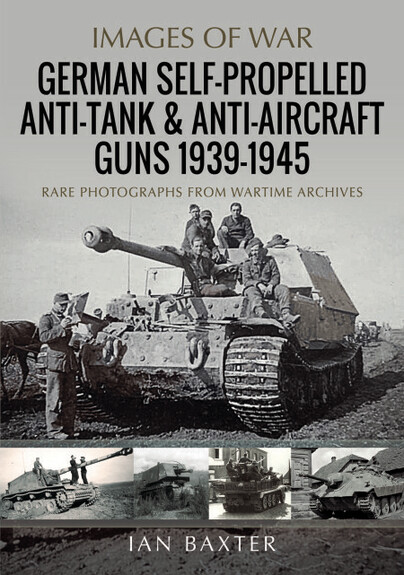
By Ian Baxter
Self-propelled anti-tank and anti-aircraft vehicles were a key element of the Nazi Army during the Second World War. Anti-tank weapons assumed great importance from the outbreak of war as combatants developed ever more effective armoured vehicles and tactics. Some were little more than stopgap solutions, such as mounting the weapons on a tracked vehicle to give enhanced mobility, while others were more sophisticated designs. Examples of the development of tank destroyer technology throughout the war are the Marders, Jagdpanzer 38, and Nashorn. In order to provide much needed fire power, vehicles like the 5-ton Sd.Kfz.6 halftrack mounted Soviet 76.2mm field guns. The Marder series played a key role supporting armoured operations with their anti-tank guns.
Anti-aircraft firepower was vital to give protection to troops from increasingly potent Allied ground-attack. The Germans also mounted anti-aircraft guns onboard halftracks such as the Sd.Kfz.10/5 and 10/4 armed with 2cm Flak guns, the medium Sd.Kfz.7/1 halftrack mounting 2cm flak guns, including quadruple flak guns on certain modified vehicles. Later in the war there was the Flakpanzer 38 (t) with a 2cm flak gun, an Sd.Kfz.6/2 Flak halftrack, and the Flakpanzer IV Wirbelwind with a rotating flak gun turret armed with quadruple 2cm flak guns.
In true Images of War style the authoritative text is superbly supported by well captioned contemporary images.
Vintage Airfix Review:
Ian Baxter is one of Pen & Sword’s most dependable contributors to the Images of War series, and this latest volume is a tightly structured, visually generous account of a subject that deserves far more attention than it typically receives. Covering the full arc of Germany’s self-propelled anti-tank and anti-aircraft development from the early improvisation of 1939 through to the sophisticated killing machines of 1944 and 1945, he charts the evolution from the humble Panzerjäger I, a Czech gun bolted somewhat apologetically onto a Panzer I chassis, through the Marder family, the formidable Nashorn, and on to the Jagdpanzer 38. The narrative is clear and methodical, placing each vehicle within the broader sweep of the campaigns it fought in, from France and the Low Countries to the grinding warfare of the Eastern Front, without ever losing the reader in a thicket of German designations.
For the modeller, this book earns its place on the workbench. The wartime photographs, many sourced from private archives, are the real treasure, offering crisp detail on gun mounts, armoured compartments, crew arrangements and field modifications of the kind that can settle an argument about stowage bins or gun shield fittings in short order. The captions occasionally repeat information already covered in the main text, and the analytical depth is sometimes thinner than the subject demands, but as a photographic reference and solid introduction to a fascinating branch of German armoured development, it comes highly recommended, particularly for anyone with a Marder or Hetzer waiting patiently on the shelf.